
Science is the story of human curiosity. It began when people looked at the sky, watched the seasons change, observed plants growing, and asked why things happened the way they did.
Students often search for who is father of science, and the answer most commonly given is Galileo Galilei. He is known as the Father of Modern Science because he encouraged people to observe, test, reason, and accept ideas only when they were supported by evidence.
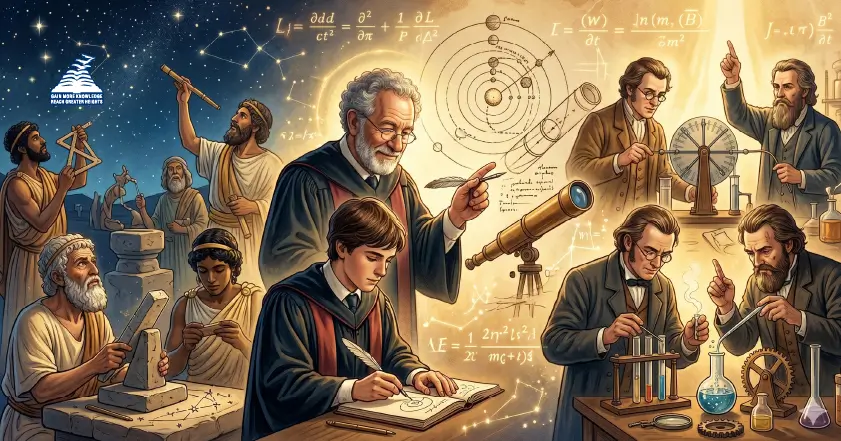
Exploring the Origins of Scientific Thought
The historical background of science is much older than modern classrooms and laboratories. Early human beings learned through observation because their survival depended on it. They studied fire, water, weather, animals, plants, and stars. Slowly, this practical knowledge helped them farm better, build shelters, prepare medicines, and understand natural patterns.
Why the Title “Father of Science” Holds Historical Importance
The title “Father of Science” is important because it represents a major change in the way people understood knowledge. Galileo Galilei questioned many accepted ideas of his time and showed that truth must be supported by proof. His work helped people move away from blind acceptance and towards observation-based learning.
Ancient Thinkers Who Shaped Early Scientific Ideas
The origins of science were shaped by many ancient civilisations. Indian scholars contributed to mathematics, astronomy, medicine, and metallurgy. Greek thinkers explored logic, nature, and philosophy. Egyptians developed knowledge in engineering and measurement, while Chinese scholars made progress in medicine, inventions, and astronomy. These early contributions created the foundation for future discoveries.
How Curiosity Became the Foundation of Discovery
Curiosity is the first step in every scientific journey. A student who asks why the Moon changes shape, how a rainbow appears, or why metals expand when heated is already thinking like a scientist. Curiosity encourages children to look beyond memorised answers and understand the reason behind a concept.
The Shift from Belief-Based Ideas to Evidence-Based Thinking
The rise of modern science changed human understanding in a powerful way. Earlier, many ideas were accepted because they came from tradition or authority. Galileo helped change this approach by using observation, mathematics, and experiments. His telescope studies made people rethink their understanding of the universe.
Importance of Observation, Experimentation, and Reasoning
The scientific revolution made science more systematic and reliable. Scientists began to observe carefully, test ideas, record results, and use reasoning before forming conclusions. This method helped people separate facts from assumptions. It also encouraged future scientists to challenge old ideas whenever new evidence appeared.
Major Scientific Milestones That Changed Human Understanding
The History of Scientific Discovery is filled with moments that changed the world. Each discovery helped people understand life, nature, health, space, and technology in a better way.
| Scientific Milestone | How It Changed Human Understanding |
| Telescope observations | Improved knowledge of planets and space |
| Laws of motion | Explained force, movement, and gravity |
| Discovery of electricity | Powered homes, industries, and machines |
| Germ theory | Improved medicine and public health |
| Periodic table | Organised the study of elements |
| Vaccination | Helped prevent serious diseases |
| Space exploration | Expanded knowledge of the universe |
Why Science Continues to Evolve with New Discoveries
Scientific Contributions are not limited to one scientist or one period of history. Every generation adds new knowledge. Galileo inspired later thinkers, Newton explained motion and gravity, Einstein changed ideas about space and time, and modern researchers continue to explore genetics, clean energy, robotics, medicine, climate science, and artificial intelligence.
Inspiring Students to Think, Question, and Explore
Science Education should help students become curious, confident, and logical thinkers. Science is not only about memorising formulas or definitions. It is about asking questions, doing experiments, observing results, and connecting concepts with real life. When students learn this way, they understand subjects more deeply and remember them for a longer time.
Learning from the Great Minds Who Built the Path of Science
Students studying in the best PU colleges in Mangalore can learn valuable lessons from great scientists. Galileo teaches courage, Newton teaches discipline, Marie Curie teaches dedication, C. V. Raman teaches curiosity, and Dr. A. P. J. Abdul Kalam teaches the power of dreams and hard work. Their journeys show that discovery needs patience and effort.
Science as a Pathway to Future Careers
Students searching for the top PU science colleges in Mangalore often choose Science because it opens the door to many career opportunities. Physics, Chemistry, Biology, Mathematics, and Computer Science can lead to careers in engineering, medicine, research, biotechnology, data science, pharmacy, space science, architecture, environmental studies, and technology.
Choosing the Right Environment for Scientific Learning
Many good colleges in Mangalore focus on helping students understand science through classroom teaching, laboratory work, regular tests, doubt-clearing sessions, and career guidance. A strong academic environment can make science less stressful and more interesting. With the right guidance, students begin to see science as a way to understand the world.
How Students Can Develop Scientific Thinking
Scientific thinking can be developed through simple daily habits. Students do not need a big laboratory to begin thinking like scientists.
They only need curiosity, patience, and the willingness to learn.
- Ask “why” and “how” questions
- Observe things carefully
- Read about scientists and inventions
- Take part in science projects
- Discuss doubts with teachers
- Connect textbook topics with daily life
- Learn from mistakes and try again
Inspiring Scientific Curiosity Through the Story of Discovery
Understanding the Father of Science and the journey behind scientific discovery helps students appreciate how curiosity, observation, experimentation, and reasoning shaped the world of knowledge. At Presidency PU College Mangalore, students are encouraged to look beyond textbooks and explore science as a subject of inquiry, innovation, and real-world problem-solving.
By learning about great scientific thinkers and the evolution of scientific ideas, students develop analytical thinking, questioning skills, and a deeper interest in Physics, Chemistry, Biology, and Mathematics. With strong academic guidance, concept-based learning, and a future-focused approach, Presidency PU College Mangalore inspires students to think like young scientists and build a strong foundation for higher education and successful careers.
Conclusion
The story of the Father of Science is also the story of human progress. Galileo Galilei is remembered because he encouraged people to observe, question, test, and believe evidence. However, science has grown through the work of many great minds across different cultures and centuries. For students, the biggest lesson is simple: every discovery begins with curiosity. When young learners ask questions and explore ideas, they take the first step towards becoming future innovators.