
If you’ve got a child in 2nd PUC (or you’re the student yourself), chances are you’ve already heard the word “KCET” thrown around in class, at coaching centres, or in nervous WhatsApp group chats. For most Karnataka students aiming for engineering, pharmacy, agriculture, or veterinary science, this one exam decides which college door opens for them. And yet, a surprising number of students from top PU colleges in Mangalore go into it without really understanding how it works.
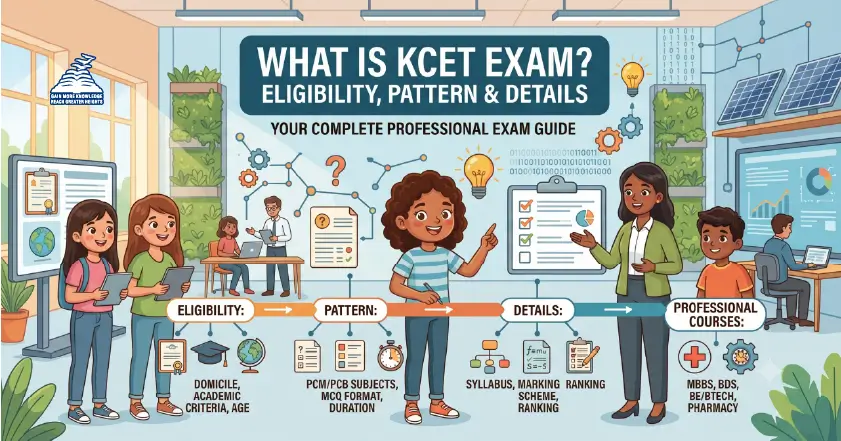
So let’s break it down properly — no jargon, no confusion, just the facts you actually need.
What Does KCET Stand For?
KCET stands for Karnataka Common Entrance Test, officially known as UGCET (Undergraduate Common Entrance Test). It is a state-level entrance exam conducted every year by the Karnataka Examinations Authority (KEA), a government body under the Department of Collegiate Education, Government of Karnataka. It is one of India’s largest state entrance exams, with more than 3 lakh candidates appearing each cycle.
In simple terms, it is the gateway exam for undergraduate professional courses across Karnataka.
Courses offered through KCET:
Engineering / B.E. / B.Tech.
B.Pharm and Pharm-D
B.Sc Agriculture (Hons)
B.VSc & AH (Veterinary Science)
Architecture — <p>though for this, candidates must have qualified JEE Main Paper-2 or NATA to participate in KCET counselling
BNYS, B.Sc Nursing, BFD, B.HSc
One thing student from the best PU colleges in Mangalore often gets confused about if you are aiming for Medical, Dental, Ayurveda, Unani, or Homoeopathy courses, you will need to qualify NEET instead, not KCET.
Eligibility Criteria: Who Can Actually Apply?
This is where a lot of students trip up, mostly around the domicile rules. Here’s what you need to check off:
- Nationality: You must be an Indian citizen
- Qualifying exam: Passed 2nd PUC / Class 12 or equivalent, with Physics and Mathematics as compulsory subjects, plus one of Chemistry, Biotechnology, Biology, Electronics, or Computer Science, and English as a language subject
- Minimum marks: 45% aggregate for general category, 40% for SC/ST and other reserved categories
- Karnataka domicile (for state quota): You need to satisfy at least one of these
- Studied for a minimum of 7 consecutive years in Karnataka-recognised institutions (any combination from 1st standard to 2nd PUC)
- Qualify as a Horanadu Kannadiga (Kannadiga family settled outside Karnataka) or Gadinadu Kannadiga (border-area Kannadiga), both of which require clearing the Kannada Language Test
| Category | Minimum Qualifying Marks |
| General | 45% |
| SC/ST/Cat-1/2A/2B/3A/3B | 40% |
Age is not usually a strict barrier — the main thing KEA checks closely is the educational qualification and domicile proof, so don’t lose sleep over exact birthdates.
Exam Pattern: What Actually Happens on Exam Day
KCET is conducted offline, in pen-and-paper OMR format — no computer-based test here. It’s split by stream depending on which course you’re targeting.
| Subject | Questions | Marks | Duration |
| Physics | 60 | 60 | 80 minutes |
| Chemistry | 60 | 60 | 80 minutes |
| Mathematics (Engineering/Tech) | 60 | 60 | 80 minutes |
| Biology (Agriculture/Veterinary/Allied) | 60 | 60 | 80 minutes |
Candidates from good colleges in Mangalore choose Mathematics or Biology depending on the course stream — Engineering aspirants sit for Physics, Chemistry, Mathematics (PCM), while those aiming for Agriculture, Veterinary, or allied courses sit for Physics, Chemistry, Biology (PCB). Each stream totals 180 marks, and every correct answer gets exactly one mark — there is no negative marking, so guessing an answer never hurts you.
A few more things worth knowing:
- The syllabus is based entirely on the 1st and 2nd PUC (Class 11 and 12) curriculum
- The final merit rank is not based on KCET marks alone for Engineering, it is a 50:50 split between your KCET score and your 2nd PUC board marks in the same subjects
- Candidates claiming Horanadu/Gadinadu status must also clear a separate Kannada Language Test
- Application fees typically range from around ₹500 for Karnataka general/OBC candidates to ₹750 for those applying from outside the state
The Overall Selection Process
- Step 1: Written exam (Physics, Chemistry, Maths/Biology)
- Step 2: Kannada Language Test (only if claiming Horanadu/Gadinadu Kannadiga category)
- Step 3: Document verification (marks cards, domicile certificate, category certificates, Aadhaar, photos)
- Step 4: Online counselling — option entry, mock allotment, and final seat allotment across multiple rounds
Your Complete Guide to KCET Exam Details, Eligibility, and Pattern — Expertly Navigated at Presidency PU College Mangalore
The Karnataka Common Entrance Test, widely known as KCET, is one of the most significant and competitive state-level entrance examinations that determines admission into prestigious undergraduate engineering, pharmacy, and allied science programs across Karnataka, and Presidency PU College Mangalore has established itself as the most trusted and comprehensively prepared institution for guiding every aspiring student through this critical examination journey with exceptional expertise and confidence.
KCET evaluates students across Physics, Chemistry, Mathematics, and Biology subjects drawn directly from the PU curriculum, making the quality of pre-university education received at Presidency PU College Mangalore an invaluable and decisive advantage for every serious KCET aspirant.
Eligibility requires students of , top 10 pu colleges in Mangalore to have completed second PUC or equivalent with Physics, Chemistry, and Mathematics or Biology as core subjects, and Presidency PU College Mangalore’s rigorously structured academic programs ensure every student meets and exceeds these eligibility benchmarks comfortably.
Dedicated KCET coaching sessions, subject-specific intensive workshops, comprehensive mock examination series, and personalized performance analysis collectively create a powerful examination preparation ecosystem that sharpens speed, accuracy, and conceptual depth across all tested subjects.
For students in Mangalore who are determined to crack KCET and secure admission into Karnataka’s finest undergraduate institutions, Presidency PU College Mangalore is unquestionably the most strategic, supportive, and success-proven choice available today.
Final Thoughts
Cracking the KCET exam is not just about scoring well on results day it is about understanding the entire process from registration to counselling well in advance. Going through the KCET exam pattern carefully helps you plan your preparation instead of guessing what to expect.
Meanwhile, brushing up on the KCET eligibility criteria early on avoids last-minute panic during document verification. If you’re still gathering KCET exam details, remember that the Karnataka Common Entrance Test is only the first hurdle the KCET counselling process that follows is just as important for landing a good seat. Starting early with the KCET syllabus genuinely makes the difference between a stressful April and a confident one.