
Enjoy solving equations but unsure what to study next? Mathematics can take you into software, building design, financial analysis and many other fields. Choosing the best courses after 12th maths starts with understanding how you like to use numbers. Salary matters, but so do your interests, learning habits and willingness to develop practical skills.
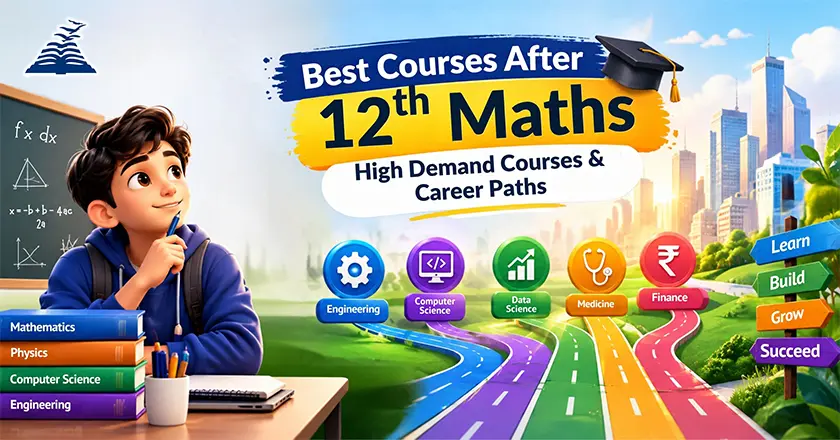
Table of Contents
Why Choose Mathematics-Based Courses After Class 12?
Mathematics teaches you to identify patterns, test ideas and work through problems patiently. These abilities are useful across technical and business careers. The range of career options after 12th maths gives students flexibility: you might build applications, analyse economic trends, assess insurance risks or design better transport systems.
Top Courses After 12th Maths for a High-Salary Career
When comparing high demand courses after 12th maths, look beyond the course title. Examine what students learn, the work graduates actually do and whether the college helps them gain practical experience.
B.Tech in Computer Science, AI and Machine Learning
Computer science combines programming, algorithms, databases and computer systems. AI specialisations add mathematical modelling and machine learning. Among the best degree courses after 12th maths, this route suits students who enjoy logical challenges. Possible careers include software development and data engineering; specialised AI roles require substantial skills and project experience.
B.Tech in Engineering and Emerging Technologies
Electronics, electrical, mechanical and civil engineering apply mathematics to physical systems. Areas such as robotics, embedded systems and renewable energy offer further specialisation. Choose a branch whose core subjects interest you. A fashionable specialisation cannot compensate for weak laboratories, limited practical training or a curriculum you dislike.
Bachelor of Architecture and Planning
B.Arch focuses on buildings, spatial design and construction, while B.Planning examines land use, transport and urban development. These are separate degrees with different admission requirements. Architecture suits students who combine numerical ability with visual thinking and an interest in how people use spaces. B.Arch is a five-year programme.
B.Sc. in Mathematics, Statistics and Data Science
For students who enjoy exploring why a method works, Mathematics courses after 12th offer rewarding academic foundations. Mathematics emphasises reasoning, statistics examines uncertainty, and data science combines analysis with computing. Career directions include analytics and research, although some specialist positions require postgraduate study. Check how much programming and applied work the programme includes.
Actuarial Science and Financial Risk Management
Actuarial work uses probability and statistics to assess financial uncertainty, particularly in insurance and pensions. Becoming a qualified actuary involves professional examinations; an undergraduate degree alone does not confer that status. The Institute of Actuaries of India offers student-entry routes through ACET and specified alternatives.
Economics, Finance and Chartered Accountancy
Students exploring maths stream career options after 12th can also consider economics and finance degrees. These connect numerical analysis with business decisions. Chartered Accountancy is a separate professional qualification involving examinations and practical training, rather than an ordinary undergraduate degree. Its Foundation route can begin around the Class 12 stage, subject to ICAI requirements.
BCA, Cybersecurity and Software Development
BCA provides a route into programming, databases and application development. Cybersecurity may be offered through specialised degrees or later training. Students should build working projects and understand computer networks alongside classroom study. Compare eligibility carefully: universities set different subject requirements, and a course title alone does not establish whether you qualify.
Entrance Exams for Courses After 12th Maths
Prepare for the entrance route your shortlisted institutions actually accept. Applying for every available examination can spread your effort too thin.
JEE, CUET, NATA, ISI and Other Entrance Examinations
| Examination or route | Main purpose |
| JEE Main | Engineering admission and separate architecture/planning papers. |
| JEE Advanced | Admission to IIT programmes, subject to eligibility and counselling rules. |
| CUET UG | Undergraduate admission at participating universities. |
| NATA | Architecture aptitude assessment for participating B.Arch admission routes. |
| ISI admission tests | Selection for programmes including B.Stat and B.Math. |
State and university entrance routes are also available. Check the current admission notice before choosing examination subjects or paying fees.
Eligibility and Subject Requirements
Having mathematics in Class 12 does not make you eligible for every programme. Engineering admission commonly involves physics and mathematics, with additional subject and marks conditions. B.Arch requires the prescribed subject combination; current rules include physics and mathematics as compulsory subjects. Economics, BCA and science degrees have institution-specific requirements.
Check required subjects, minimum marks, accepted entrance scores and counselling conditions separately.
High-Salary Career Paths and Factors That Influence Earnings
Career paths worth investigating include software engineering, data analytics, actuarial work, financial risk analysis and specialised engineering. Earnings depend on expertise, experience, employer, location and responsibility.
When reviewing college placements, ask for:
- Median salary and the number of students placed.
- Roles offered to graduates from your chosen course.
- Internship opportunities and practical training.
- Fixed pay separately from bonuses and other package components.
An exceptional advertised package is not a reliable estimate of what every graduate will earn.
How to Choose the Right Course Based on Your Interests
Try a small task before committing write a basic program, analyse a dataset, sketch a building layout or examine a company’s accounts. Notice which activity keeps you interested when it becomes difficult.
Parents comparing the best PU colleges in Mangalore should ask how teachers strengthen mathematical understanding and help students explore different careers.
When evaluating a top science PU college in Mangalore, look for subject guidance, practical learning and a manageable preparation schedule. A strong foundation helps students make informed degree choices.
Prepare for a World of Possibilities at Presidency PU College Mangalore
An interest in mathematics can open doors to engineering, technology, data science, finance and many other fields. Presidency PU College Mangalore is one of the best pu colleges in Mangalore that encourages students to strengthen their subject knowledge, develop analytical thinking and approach their next academic step with confidence. With an emphasis on academic growth and personal development, the college helps young learners build a foundation for further studies and future ambitions. Begin your journey towards a rewarding career with an education that gives your potential room to grow.
Conclusion
The best course after 12th maths is one that matches the problems you enjoy solving and the work you can see yourself doing. Shortlist a few options, try a small project in each area, and compare course content, eligibility and practical training before you apply. A high starting salary may be appealing, but lasting career growth comes from building skills in a field that holds your interest.